

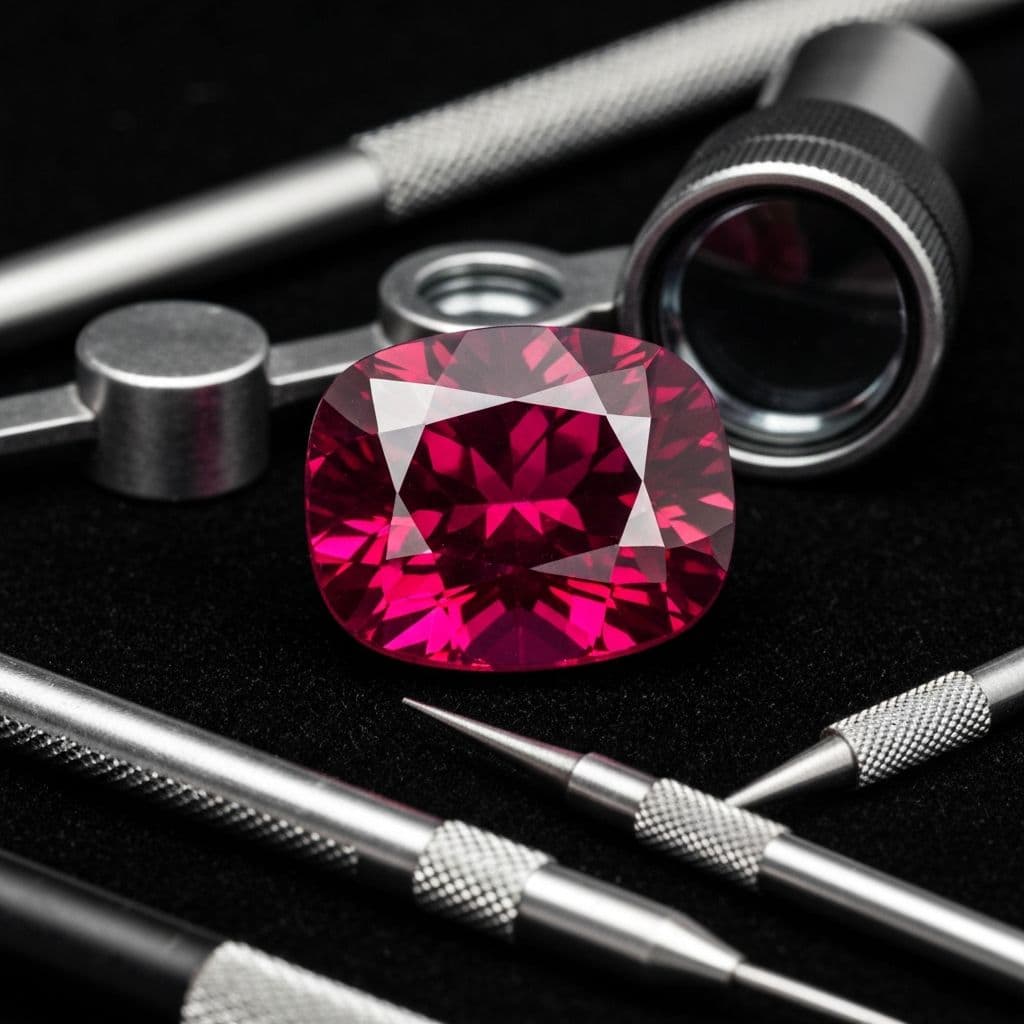
While the "Four C's" were originally developed for diamonds, coloured gemstones require a nuanced understanding of these criteria. Unlike diamonds where cut and clarity reign supreme, coloured gemstones place colour as the paramount factor in determining value and desirability.
1. Colour: The Most Critical Factor
In coloured gemstones, colour accounts for approximately 50-70% of a stone's value. When evaluating colour, gemologists consider three essential components:
- Hue: The dominant spectral colour of the gemstone. For rubies, the most prized hue is "pigeon blood red" - a pure red with subtle blue undertones.
- Saturation: The intensity or vividness of the colour. Highly saturated stones with vivid colours command premium prices.
- Tone: The lightness or darkness of the colour. The ideal tone varies by gemstone type but generally falls in the medium to medium-dark range.
Expert Insight
"The finest Kashmir sapphires exhibit a velvety, cornflower blue that seems to glow from within. This phenomenon, caused by microscopic inclusions, is actually what makes these stones so valuable - proving that in coloured gemstones, the rules are beautifully complex."
2. Clarity: A Different Standard
Unlike diamonds, where clarity is judged under 10x magnification, coloured gemstones are graded "eye-clean" - evaluated with the naked eye at a normal viewing distance. This is because inclusions are far more common and expected in coloured stones.
In fact, certain inclusions can add value. The "silk" in fine Burmese rubies and Kashmir sapphires creates a prized velvety appearance. Colombian emeralds are expected to have inclusions, lovingly termed "jardin" (garden), which actually help authenticate their origin.
3. Cut: Maximising Beauty
The cut of a coloured gemstone serves a different purpose than in diamonds. Rather than maximising brilliance through precise mathematical proportions, the cut of a coloured stone aims to:
- Optimise the stone's colour presentation
- Minimise the visibility of inclusions
- Maximise carat weight from the rough
- Create pleasing proportions and symmetry
Common cuts for coloured gemstones include oval, cushion, and emerald cuts, which tend to showcase colour better than brilliant cuts designed for diamonds.
4. Carat Weight: Size Matters Differently
Carat weight measures a gemstone's mass, with one carat equalling 200 milligrams. However, density varies significantly between gemstone types. A one-carat ruby will appear smaller than a one-carat emerald due to ruby's higher density.
Price per carat increases exponentially with size for fine gemstones. A 5-carat ruby of fine quality may cost more than five times the price of a comparable 1-carat stone, as large, high-quality rubies are exceptionally rare.
The Glowgem Difference
At The Glowgem, every gemstone is evaluated by our expert gemologists using these criteria, ensuring you receive detailed information about each stone's unique characteristics. We believe in complete transparency, providing certification from recognised laboratories for all significant purchases.
Beyond the Four C's
While the Four C's provide a foundation for evaluation, coloured gemstones require consideration of additional factors:
- Origin: Gemstones from certain localities command premium prices. Kashmir sapphires, Burmese rubies, and Colombian emeralds are the most coveted.
- Treatment: Natural, untreated gemstones are increasingly rare and valuable. Heat treatment is common and accepted, but other treatments may significantly impact value.
- Phenomena: Special optical effects like asterism (star effect) or colour change can dramatically increase a stone's desirability.